What is "The Mind"?
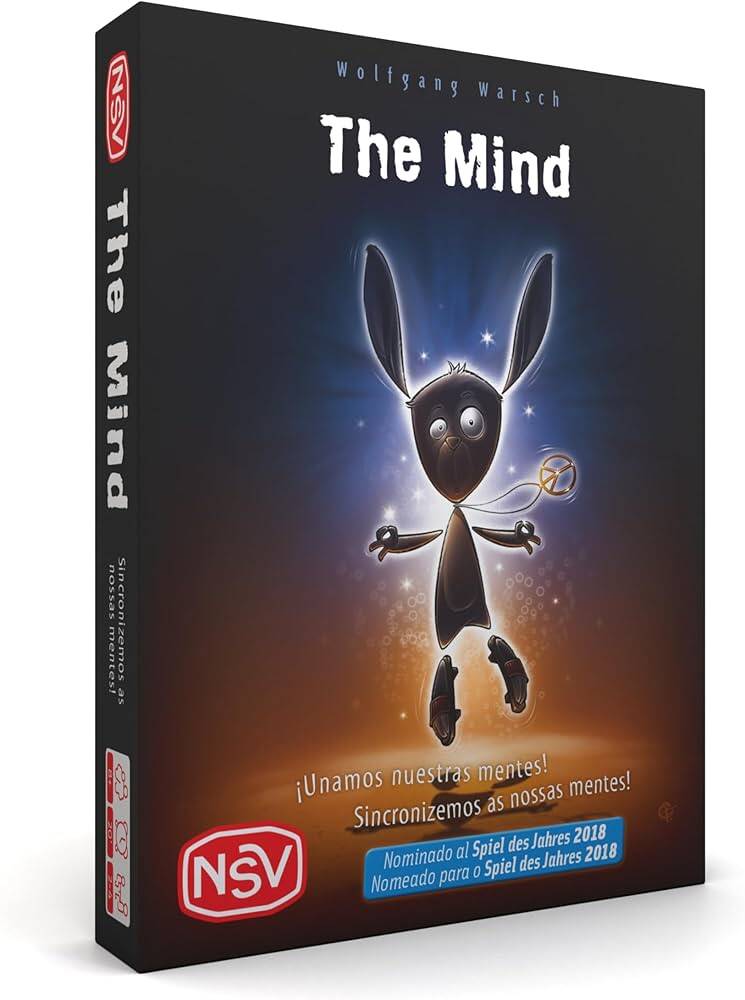
The Mind is a cooperative game designed by Wolfgang Warsch and originally published in 2018 by Nurnberger-Spielkarten-Verlag, or NSV.
The game seats two to four players and takes about 20 minutes - although we find the more you play it the better you get and the further you'll progress, which adds a bit to the playtime.
The box is tiny, fitting into a coat pocket. It contains:
-
A deck of 100 cards numbered 1 to 100
-
12 level cards that dictate the level and size of each player's hand
-
5 life cards
-
3 shuriken throwing star cards (if these seem out of place, you're not alone - keep reading and we will explain the connection)
There's no board and barely even a rulebook - the whole thing fits on one folded sheet. It's recommended for ages 8+, which makes sense to us having played it a few times.
The aim of the game is to work together - in complete silence - to play numbered cards from each of your hands. There is no turn order, you just place a card one at a time into a single discard pile. The tricky bit? They need to be in ascending order. The really tricky bit? You can't say a word to your teammates or signal the value of your cards in any way.
Why should you play "The Mind"?
The Mind is one of those rare games that can make you feel genuinely clever. Not because of what's written on the cards or how you approach the game, but because of what's happening between the people playing it.
Unlike most board games, which reward logical thinking and clever strategy, The Mind is built entirely on something instinctive: the ability to tune into other people.
Psychologists call this affective empathy - the ability to pick up on what others are feeling and respond to it in real time. In The Mind, where you work together in silence, your only tools are being able to notice the micro-expressions and tiny pauses.
That's what makes the game so gripping. It's a deceptively simple way to encourage players to spot the subtle cues they'd normally tune out. You're learning to listen to the people in the room with you.
This game is therefore perfect for people who are more about feeling than strategy. And if you've ever felt that traditional board games aren't really your thing, this might be the game that changes your mind.
What do the trustees at VonCon think?
"The Mind is a game that challenges players to play not within the constraints of the rules, but within the constraints of how we read and respond to people themselves.
And because the rules are so simple, it almost feels like it shouldn't be called a game at all, which makes it really interesting to play!"
Max Gawryla, Trustee and Demogod
How you play play "The Mind"?
Preparation
Before diving into the game, it's worth knowing that the game scales depending on how many of you are playing. More players means fewer levels to beat, but also more minds to sync up. Here's how it breaks down:
| Number of players | Levels to beat | Number of starting lives | Number of starting throwing stars |
|---|---|---|---|
| 2 | 1-12 | 2 | 1 |
| 3 | 1-10 | 3 | 1 |
| 4 | 1-8 | 4 | 1 |
Once you know how many of you are playing, place the right number of life and throwing stars on the table. Stack the level cards in ascending order, with level 1 on top and ready to go.
Shuffle the 100 numbered cards and deal a hand to each player equal to the level you're on. Level 1? One card each. Level 9? Nine cards each.
Here's the golden rule: the moment cards are in your hands, you cannot share any information about what you're holding. Not a word, a wink nor a suspiciously timed cough.
You can, however, look at your own cards and organise them in a way that feels natural to you - just don't show anyone else.
When you are ready, place both hands on the table to signal you are ready for the game to start.
Playing
The goal is both beautifully simple and absolutely maddening: every player needs to empty their hand into a shared discard pile in the middle of the table, in ascending order. And remember, you can't communicate with each other at all.
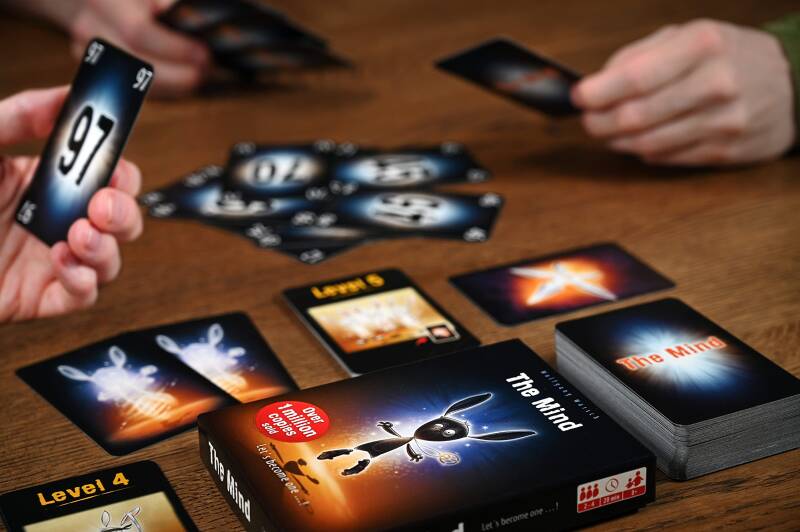
There's no turn order, no prompts and no "after you". Whoever believes they're holding the lowest card in their hand plays it, face up, into the central discard pile. One card at a time, even if you've got a few you want to play.
It sounds simple. It is not simple!
Losing a life
It happens to everyone. Someone plays a card and - whoops - someone else is sitting there with something lower. The moment that happens, whoever holds the lower card interrupts play immediately. One of the team's life tokens goes back in the box. Gone.
Every player holding a card lower than the one just played has to discard those cards face down into the general supply (the team will only lose one life, even if there are multiple cards).
Providing you still have at least one life card left, play continues from the card that caused the chaos and there's still a chance you've got this in the bag.
Example turn
The number on the table is a 29. You're holding the number 47. You have no idea what anyone else has, and you can't ask. You can't even narrow your eyes at someone to hint that you are thinking about playing a card.
Someone puts down a card. It's a 35. Silence. That means nobody had a card between 29 and 35. Good. Fine. But you still have the 47.
The silence stretches. It's been maybe eight seconds but it feels so much longer. Someone else breaks the stalemate and puts down a 39. Then, almost immediately, a 44.
Your moment is here. The chances of someone holding a card between 44 and 47 feel pretty slim, so you move the card towards the table.
But before you can reveal it, someone else fumbles with their hand and slaps down a 48.
"Bah!" You throw down the 47 and the whole table gives a collective groan. You lose a life because the group telepathy failed you once again and, because the team still has one more life card left, play continues from number 48.
Winning a level
When every player has played their last card and the hands are empty, you have completed the level. You've done it.
And it gets better: check the bottom right corner of the level card you just beat. Some levels reward you with a bonus life or an extra throwing star. A little gift for being able to read each others' minds so well.
Using a throwing star
Sometimes things get a bit sticky. At any time during play, you can raise your hand to suggest using a throwing star. If everyone agrees - by raising their hands too - you activate it.
All players discard the lowest value card face up, so everyone can see what's going on.
The throwing star goes back in the general supply and play continues from the highest value card on the table.
Ending the game
Beat every level for your player count and you all win - together. Through nothing but a shared sense of telepathy.
Oh, and if you do win, you can do the whole thing again but with the cards face down. Spoiler: The Mind is orders of magnitude harder when you're playing blind!
However, if you lose that last life before you get to the end? The whole team loses. No restarts, unless it's from level 1. The Mind is rather unforgiving with its endings.
Either way, you'll want to play again immediately - everyone always does.
Our verdict: yes, you should absolutely play this game
The Mind is one of those games that genuinely surprised us. In fact, when Max and I finished our first play through, it sparked a conversation about whether something so rules-light was even a game to begin with.
In fact, after Max had explained the "rules" I wondered how something so simple was ever nominated for a Spiel des Jahres award (in other words, Game of the Year).
But its simplicity won me over and getting a run of similarly valued cards on the table, in the right order, got audible celebrations from both of us.
And when we lost - and we lost a lot - I found myself surprisingly invested. It's quick enough that it became incredibly easy to just say "one more try?".
It's a brilliant choice of game for people who don't want to spend hours learning rules. Or for those who find loud, chaotic party games a bit too much. The Mind is calm, focused and oddly intimate - you're not shouting over each other, you're tuning in.
A small caveat worth mentioning: if you're someone who finds silence uncomfortable, The Mind might test you a little. The whole game lives in the quiet, and if your instinct is to fill every gap with chatter, you'll need to resist the urge (which, honestly, can be part of the fun).
It also plays best with people who are genuinely willing to slow down and be present. It's definitely not one to pull out if half the group is distracted by their phones.
But for the right group? It's actually quite special. There's something about the shared focus of The Mind that brings people together in a way that's hard to put into words, which is fitting, really, given that the whole game is about communicating without them.
Where can you play "The Mind"?
If you're curious and want to try it out, come along to a VoNCon event - we'll have it on the table and someone ready to walk you through it.
Just pull up a chair and see if you can read our minds.
Add comment
Comments
I love this game. It’s quiet to begin with but then you will often have collective groans or loud celebrations when you’ve pulled off a blinder of a round. Especially when the cards are so close to each other!
If the group don’t agree with you on using a throwing star by putting their hands up, play just continues doesn’t it? It’s been a while since I’ve played it.
I might even teach it at tonight’s gaming session in Resolven!
Also… 47!!