
Trustee and DemoGod, Max Gawryla explains why his love of board games and love of horror don't mesh, and discusses some of the psychology behind it.
It's October, which means I get to embrace the macabre.
This is the one stretch of the year where it's socially acceptable to revel in my love of horror: the films, the series, the skeletons on every shelf. I could talk about all of it for hours. But this is a board game blog, and while I'd love to ramble about the spooky aesthetic, pumpkins, and the finer points of a slow-burn ghost story, this isn't the place for that.
So instead, I want to take a look at horror on the tabletop instead. Specifically, I want to look at why my two passions don't mesh, and I wanted to know why that is.

As a former scaredy-cat...
I wasn't always a horror fanatic. In fact, I used to be terrified of the idea of being terrified. Growing up, 30 second horror movie trailers on network television would give me nightmares; I abandoned the family favourite film Jumanji because the opening sequence was too intense for me; I even cried on a family vacation at Disneyworld because I thought the O Canada gift shop was the entrance to a roller coaster. Suffice it to say, I couldn't handle even the slightest spook.
By the time I was an undergraduate, I was able to watch spooky media like American Horror Story and The Walking Dead, but I would still turn the volume to near silence when I could sense a jump scare looming. It wasn't until I was in graduate school that I got into Halloween properly and went to the theatre for a horror movie for the first time to see the 2019 remake of Stephen King's It.
Then the pandemic hit and I got weirdly comfortable watching horror on my own. I watched every half-decent spooky film I could find on streaming. I became obsessed.
These days, I find horror fun. It's become a weird comfort and has easily become one of my favourite genres of film, tv, and novels. You would think, given my love of board games, that arc would carry over to gaming as well, but it really hasn't. While I still opt for the stranger, spookier aesthetics in roleplaying games like Mothership and Heart (a game I will be running at November's Community Campaigns event), horror tabletop games have never scared me.
I've felt tension from games like Blood on the Clocktower where I was fighting not to get caught out in a lie, or in Escape from the Aliens in Outer Space when I was being hunted by my friends. One notable time at a Magic: The Gathering prerelease, my watch interrupted my game to let me know my heart rate was abnormally high and asked if I wanted to start tracking a workout.
But despite loving the racing pulse and excitement I get from a good slasher, I've never truly been scared playing a board game.
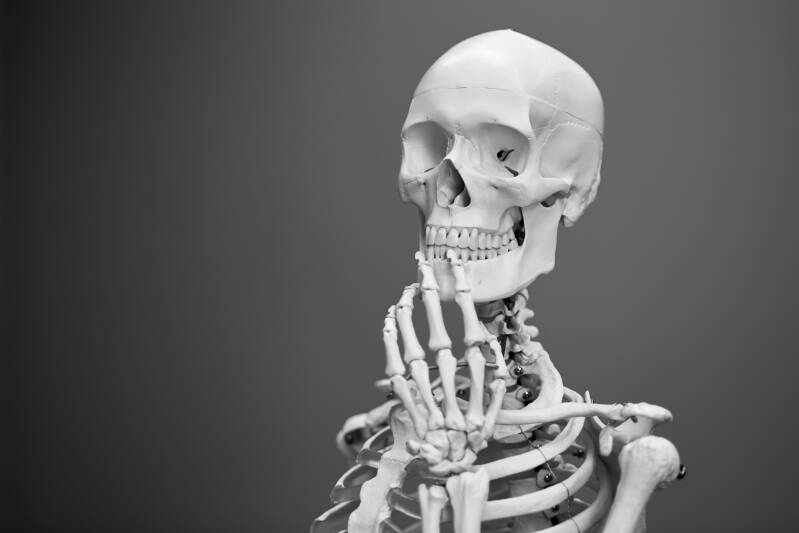
What makes something Scary?
If you'd asked me as a child, the answer probably would have been "everything." In retrospect, I think the Jumanji opening sequence scared me less because of what was on screen than because of what was missing in my head. I didn't yet have the mental framework that says: this is a constructed thing, and I'm safe. Fear, at its simplest, is the gap between what's happening and what you believe you can do about it. A kid with no frame has a very wide gap.
The horror author H.P. Lovecraft opened his now-famous essay Supernatural Horror in Literature by declaring that "the oldest and strongest kind of fear is fear of the unknown." In a lot of ways, he's right. What you can't see or don't know, you can't plan for. That's why monsters in films often get scarier the longer they stay as offscreen threats: barely shown, but always felt.
This sits in direct contrast with what a board game provides. Lovecraft's most notable creation, Cthulhu, has inspired countless board games and expansions over the years, which is a little ironic for a mythos about cosmic horror too vast for the human mind to comprehend. In a game like Arkham Horror or Eldritch Horror, the incomprehensible becomes dice, tokens and a doom track. Games can certainly hide things, through face-down cards, random draws and apps that conceal the layout. But because they run on rules, they struggle to maintain the genuine unknown. You may not know the outcome, but you can usually know the odds.
The Gothic novelist Ann Radcliffe saw a useful split in this back in the 1820s. Terror, she argued, is the anticipation: the creak on the stairs, the door that's slightly open. Horror is what's waiting when you push it.
Stephen King later added a third, lower rung to the framework in his non-fiction book about the genre, Danse Macabre: revulsion. King ranked terror as the finest of the three, and revulsion as the lowest. Revulsion is far more hardwired than fear and doesn't resolve into a thrill. While gruesome artwork might revolt or disgust us, if it doesn't translate to an emotional response desired by the designer, it doesn't make a game fun and is therefore the least valuable rung of the horror ladder to try to implement in the mechanics of a game.
However, terror is exactly what games struggle to build. A good example of this might be the game Betrayal at House on the Hill. As you explore the house, every omen card you draw makes the next "haunt roll" more likely to flip the game into its second phase. That's a clever attempt at dread, a ratchet tightening with every turn.
But before the haunt occurs, nothing in the house can seriously threaten you, so the anticipation has no teeth. Once the haunt begins, the monster, the objective and the rules of engagement are revealed all at once, and the game becomes a known scenario with a win condition.
It's anticipation without stakes, then stakes without anticipation. The "too late to turn back" moment does exist, but it arrives at the same instant as the answer, so there's never a stretch where you're both uncertain and in danger. And that's what terror needs. The game does keep one lingering mystery, since the heroes don't know exactly what the traitor's side is trying to do. But that's more puzzle than dread.
Then there's the tool that film and TV can use and board games mostly can't: the jump scare. When I turned the volume down during a scary movie, I was trying to avoid the startle reflex, pure biology that fires in response to a potential threat before you've decided to do anything. Most turn-based games can't startle you, because you never have to react without thinking. A clever GM may be able to use a loud sound effect in a roleplaying game for a cheap thrill, but being startled is not the same as being scared.

The room holds the frame
I've written before about the magic circle, the idea that when a group sits down to play, a shared, temporary world comes into being. A wooden cube becomes a city, and a dice roll becomes the difference between life and death. What makes it work is the implied consent of everyone at the table to treat the game as meaningful.
The benefit of the magic circle is a low-risk space for experimenting, negotiating and connecting, with a safety net firmly in place. I still think that's one of the best arguments for playing games. But the magic circle has a flip side. The same safety net that makes it a safe space to experiment and explore also reduces the potential for strong emotions, either positive or negative.
Another ludologist, Jesper Juul, presents a useful, related lens in his book Half-Real. Juul describes games as being played by real rules while imagining a fictional world. The dragon isn't real, but winning and losing are. His classic game model also says the consequences of a game are optional and negotiable, which is exactly why a rivalry inside the circle doesn't follow you home.
At the table, that agreement is constantly visible. The lights are on, someone's laughing, and everyone present is helping maintain the fiction, which also means everyone is helping you remember that it's just that: fictional. Every time someone checks a card or argues about a rule, the real half of the game takes the lead and the fiction takes a step back.
Many role playing games recommend using safety tools like the X-Card and Lines & Veils which let a group steer the content away from discomfort and keep things fun. These tools deliberately maintain the circle and make the space inviting and fun for everyone, but they also build an environment that's the opposite of where fear thrives.
It's all very reminiscent of the circle used to keep a monster out in a horror movie, but in tabletop gaming, instead of being made of salt to repel a demon, it's theoretical and magic and keeps out the horrors of the real-world.
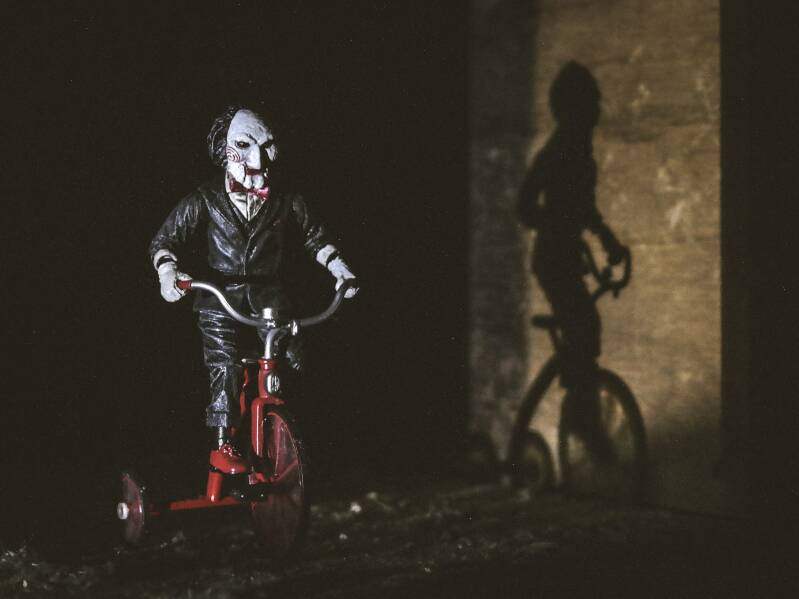
Fun fact: in the original script the 'game' Jigsaw wanted to play in the Saw franchise was actually Quacks of Quedlinberg.
When the circle gets strained
If the circle protects us from fear, then the games that come closest to scaring me should be the ones that put pressure on it. And that's exactly what I see.
Blood on the Clocktower is the clearest case. You're asked to lie to your friends' faces, convincingly, for an hour, and it's an absolute blast the whole time.
I argued in my magic circle post that "no matter what happens within the game, the circle ensures relationships remain intact in the real world." That's the promise. But it's a promise you can feel straining when you're the one lying, because you're asking everyone at the table to trust that the circle holds.
The pulse-racing sensation I get there could well be that: not fear of a monster, but the thrill of standing near the edge of the circle.
Escape from the Aliens in Outer Space works similarly. You're hunted, and the unpredictable part is another person.
Perhaps the most interesting design choice to try to evoke horror comes from a game called Final Girl. In this game, you play as the titular final girl: a trope in horror that only one character (usually the leading actress) is the only one to survive the film. The game has a massive catalogue of expansions, all of which feature familiar (if legally distinct) horror villains. The first scenario features a hulking butcher stalking a summer camp. Others have supernatural killers who hunt you in your dreams.
Unlike most of the games we play or talk about at VoNCon, Final girl is explicitly a solo-player game. It is meant to be a one-player experience from start to finish. There's no one else at the table with whom to share the blame, no one to make a joke when a victim dies, and no one to remind you it's only a game. You hold the circle all on your own, which makes it a much more fragile thing.
Even so, Final Girl isn't a perfect answer. It's still turn-based, so you still get time to think, and its dice add luck that can make the tension feel more like gambling than dread. But it shows what happens when a designer starts from the right question: not "how do I make a scary monster?" but "what does the circle give the player that I can take away?"
Despite all of these factors, there is one type of game I haven't mentioned yet which absolutely has managed to scare the pants off me.
Video games.
Even though we often lump them all in under the category of 'Games', video games break pretty much every rule I've discussed above. Despite my exposure, it took all my will to play Subnautica, a game which I don't even think of as horror, it just happens to have some big monstrous creatures in it. I've abandoned games like Alien: Isolation and others like it. I will happily watch others playthrough the games (an experience more similar to a movie), but I can't play them myself.
In a film, the protagonist is in danger. In Alien: Isolation, you are, with no weapons and real-time consequences. Sound, darkness and first-person perspective do the rest. Video games remove time, take away your safety and control your senses. Board games hand you all three.

I suspect I could make playing board games more scary by hosting my game nights in places like this.
The bottom line
I don't think tabletop horror has to scare me to be worth playing. It's a place to embrace the aesthetic, the dread and the Gothic and the Halloween-style spookiness of it all, without succumbing to terror. That might make it the perfect gateway for anyone who, like past-me, can't handle the real thing.
But I'm still chasing that racing pulse. What would a tabletop game have to strip away to get me there? Time to think? The lit room? The reassurance of other people? I'd love to hear if you've ever been scared at the tabletop by a game, or if not, what your favourite horror themed game. Because for me, it isn't always about being scared, sometimes it's more than enough just to be a little spooky.
About the author

Max Gawryla is a Trustee at VoNCon, leading our outreach and fundraising events. He also volunteers as a Demogod at VoNCon's gaming sessions on the first Saturday of the month at Bryncoch Community Centre.
Please add a comment below or contact Max through info@voncon.org to discuss his post.
Add comment
Comments